
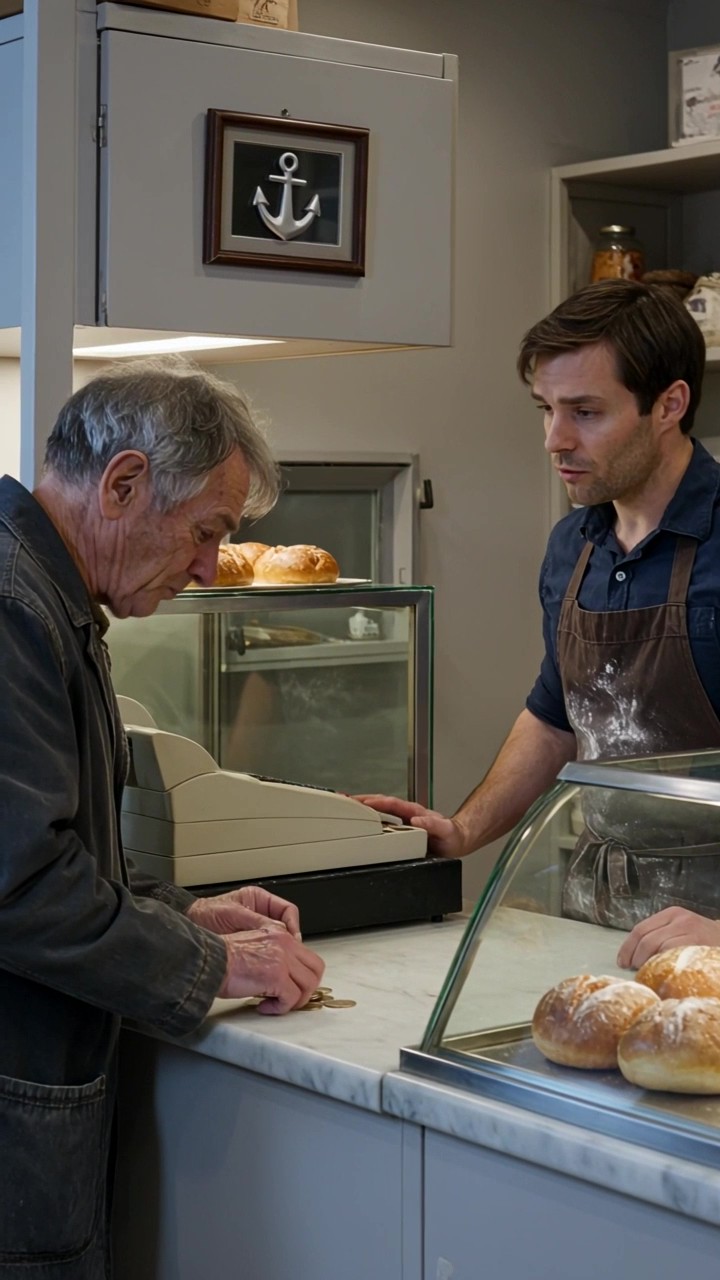
The old man stared at the silver anchor button.
For a long moment, he said nothing.
Then he looked at Noah’s face, the bakery shelves, the warm lights, the trays of bread cooling behind the counter.
“I’m sorry,” he said. “I don’t remember.”
Noah smiled, but his throat tightened.
“I do.”
The man touched the empty place on his coat.
“I lose buttons all the time.”
“You gave this one a job.”
The old man looked embarrassed.
“I must have had more money then.”
Noah shook his head.
“You had six dollars.”
The man laughed softly.
“That sounds about right.”
Noah came around the counter and pulled a chair from the corner table.
“Sit down.”
“I don’t want trouble.”
“You’re not trouble.”
The man sat as if accepting kindness required more strength than walking in the snow.
“What’s your name?” Noah asked.
“Henry Bell.”
Noah knew that name.
He had seen it on the community assistance list the church sent every month. Henry Bell. Retired dock carpenter. Widow. Behind on heating bill. Declined urgent aid box.
Too proud.
Too cold.
Noah went to the back and filled a bag.
Rolls.
Soup.
A loaf of bread.
A small chocolate cake with a red heart on top.
Henry watched him.
“I can’t pay for all that.”
“You already did.”
Henry’s eyes filled.
“No, son. A few dollars years ago doesn’t buy this.”
Noah placed the cake on the table.
“It bought my mother one night where she felt remembered. It bought me the idea that food can arrive without humiliation. It bought this bakery.”
Henry looked around again.
“The Warm Box.”
Noah nodded.
“I named it after the cake box.”
The old man pressed the silver button into his palm.
“I don’t deserve to be made into a story.”
Noah sat across from him.
“You’re not a story. You’re a seed.”
Henry laughed through tears.
“That’s worse.”
“It’s true.”
That winter, Henry began coming every Thursday. At first, he sat in the corner and fixed broken chair legs so he could pretend he was not receiving help. Then he repaired the front door. Then he built wooden bread crates with handles low enough for children.
Noah never asked him to explain why life had narrowed.
Henry never asked Noah to stop thanking him.
They found a rhythm.
One night, Noah’s mother came in and saw Henry tightening a screw on the pastry case.
She looked at him for a long time.
“You were the man in the bakery.”
Henry lowered his head.
“I think I was.”
She took both his hands.
“I had forgotten my own birthday that year. My son didn’t.”
Henry whispered, “He had a good heart.”
She smiled.
“He had help keeping it warm.”
By spring, Noah placed the silver anchor button in a new display near the door.
Under it were eight words:
Small kindness can become shelter for strangers.
Henry hated the display but visited it every week.
When children came in short on money, Noah still let them leave with what they came for.
Sometimes he slipped a button into the box.
Not always silver.
Sometimes plastic.
Sometimes wooden.
Each one carried the same meaning:
One day, when you can, close something good around someone else.





Leave a Reply