
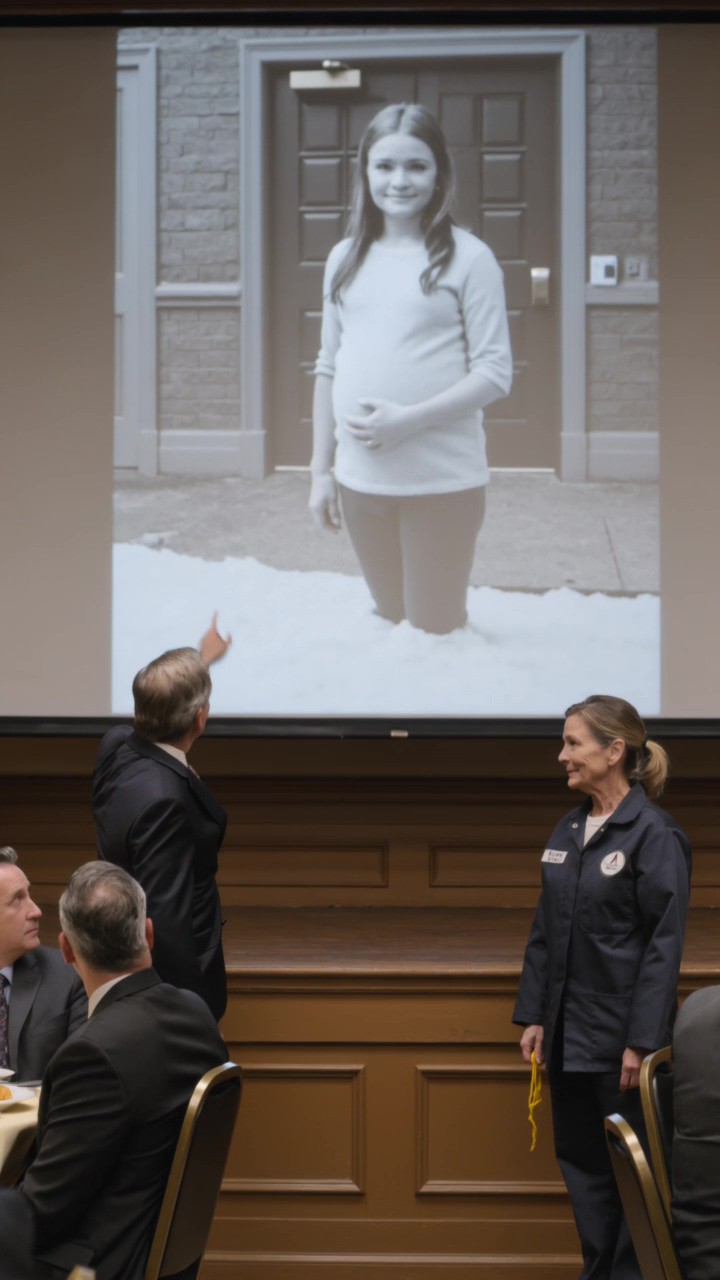
Ruth Miller stood between two security guards, unable to move.
Anna crossed the banquet room.
Nobody clapped.
Nobody spoke.
The reunion did not belong to the donors.
It belonged to two women who had spent eighteen years carrying opposite halves of the same lie.
Anna stopped in front of Ruth.
“You look the same.”
Ruth almost laughed.
“That is not true.”
“Your eyes do.”
The young woman in the yellow coat stepped closer.
“My name is Grace.”
Ruth looked at the faded blanket around her shoulders.
“The baby?”
Anna nodded.
Ruth covered her mouth.
She had driven through a blizzard with one hand on the steering wheel and the other reaching back whenever Anna cried out from beneath the linen bags.
At the farm safe house, the women had rushed Anna inside.
Ruth left before sunrise because the fewer people who knew the location, the safer it remained.
She never learned what happened next.
Grace held out the edge of the yellow blanket.
“My mother said you tied this around the van handle so she could find the door in the dark.”
Ruth touched the white-thread repair.
“I tore it on the latch.”
Anna smiled through tears.
“You apologized for that too.”
Charles Whitmore stood beside the stage holding the brass key.
His face had lost all authority.
“Anna, the shelter board was told you had vanished.”
“I did.”
“Why did you never contact us?”
Anna looked at the old photograph.
“Because the man watching the shelter had friends who asked questions in every town where I used my name.”
The room grew still.
She did not describe every harm.
She did not need to.
She said only what belonged to her.
“He checked shelters first. Ruth knew that. So she gave him the story he expected—a locked door, a cruel worker, a girl sent away.”
Charles looked at Ruth.
“You could have told the board privately.”
Ruth shook her head.
“Someone inside had already disclosed Anna’s arrival time.”
The board members exchanged looks.
One elderly donor sat down slowly.
Anna continued.
“The farm director told Ruth not to contact us. Then she moved me again when the man found the county. Every move depended on nobody connecting Ruth to my safety.”
Charles lowered the key.
“But your reputation…”
Ruth looked at Grace.
“Was not a person.”
The sentence quieted the room more completely than anger would have.
Ruth had lost work.
Friends.
Her church community.
She had spent years being recognized in grocery lines as the shelter worker who failed a pregnant girl.
Those losses mattered.
But she refused to use them to make Anna feel indebted.
Grace walked to the display wall and removed the enlarged photograph.
A board member started forward.
Anna lifted one hand.
“No. That picture does not teach what you think it teaches.”
She placed it face down on the stage.
“The door was locked because someone dangerous needed to see it locked.”
Charles looked at the guests.
“We owe Ruth a public correction.”
Ruth answered immediately.
“You owe the next worker a confidential way to report a protective decision without exposing the person being protected.”
That was the difference between apology and reform.
Haven House commissioned an independent review of the old case.
The review could not identify every person who had leaked Anna’s arrival information because records were incomplete.
It did confirm that the original board had fired Ruth without interviewing the farm safe-house network or considering that a visible refusal could have been protective.
The shelter changed its emergency protocols.
Staff could trigger a confidential relocation procedure without creating a public intake record visible to ordinary administrators.
Protective decisions were reviewed by an external advocate trained in safety planning.
No single director held the entire secret.
Ruth’s employment record was corrected.
The newspaper published a new story.
She refused to pose beside the old photograph.
Instead, she agreed to be photographed holding the brass laundry key while Grace held the yellow blanket.
The caption read:
A LOCKED DOOR CAN BE PART OF AN ESCAPE WHEN THE DANGER IS WATCHING THE ENTRANCE.
Anna and Grace stayed in town for three days.
On the final evening, they sat with Ruth in the Haven House laundry room.
The new machines hummed.
Grace folded towels badly.
Ruth refolded them without comment.
Anna asked the question Ruth had avoided.
“Did you hate me for staying silent?”
Ruth looked at the yellow yarn around the key.
“No.”
“Did you hate me for not coming back sooner?”
Ruth took longer to answer.
“Sometimes.”
Anna nodded.
Both truths could live in the same room.
Ruth had protected her.
Ruth had also paid a price Anna had not been ready to witness.
Grace placed the blanket across all three of their knees.
“My mother says you saved us.”
Ruth looked at Anna.
Anna shook her head gently.
“Do not make it smaller.”
Ruth’s eyes filled.
“All right.”
She touched the repaired yellow fabric.
“I helped open another door.”
Grace smiled.
“After pretending to close one.”
The old anniversary display was replaced.
No villain photograph.
No simplified lesson.
Only the brass key, the yellow blanket, and three sentences:
PROTECTION DOES NOT ALWAYS LOOK KIND FROM THE OUTSIDE.
SECRECY CAN SAVE A LIFE, BUT IT MUST NOT LEAVE THE PROTECTOR COMPLETELY ALONE.
THE PERSON BEING PROTECTED DECIDES WHEN THEIR STORY CAN BE TOLD.
Ruth did not return to shelter work full-time.
She had built another life.
But once a month, she trained new night staff on the hardest question:
“What must the danger believe in order for the person to escape?”






Leave a Reply