
No child was injured.
The shuttle driver suffered a bruised shoulder from trying to hold the steering wheel while the vehicle rolled.
The black SUV sustained major body damage.
The hotel barrier cracked.
Malik Reed spent forty-seven minutes in handcuffs.
Every one of those facts belonged to the same incident.
The hotel’s first mistake was trying to make only one of them the entire story.
The shuttle carried eight children from a family reunion to an indoor activity center across the hotel complex.
The driver, Rachel Cole, stopped on the upper garage loading level.
She placed the transmission in park.
Applied the mechanical parking brake.
Then stepped out to assist a child using a mobility aid.
The engine remained running because the air conditioning was needed.
The loading area sloped gently toward the garage exit.
A properly secured shuttle should not have moved.
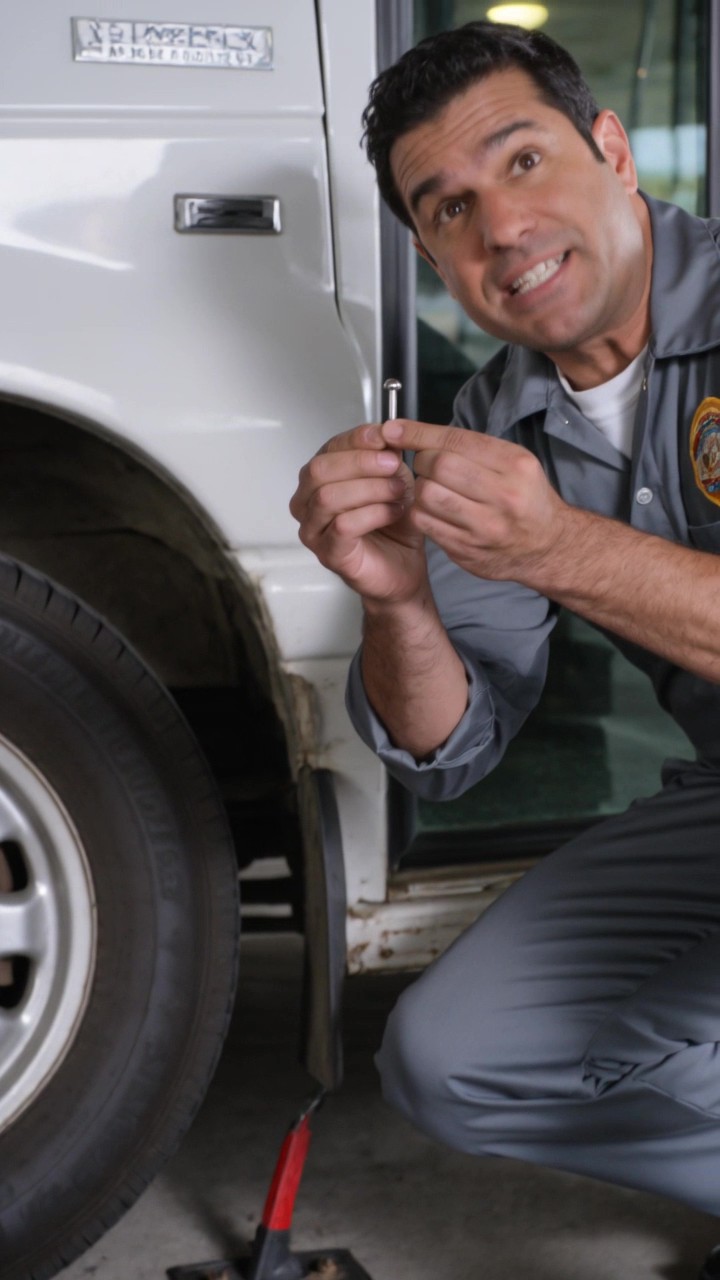
A linkage pin connecting the parking-brake lever to the rear cable had been installed during maintenance two weeks earlier.
The replacement pin was the correct diameter.
Its retaining clip was not.
The clip had worked partly free.
When Rachel applied the brake, the lever rose normally.
The cable did not remain fully engaged.
The transmission’s parking pawl held the shuttle at first.
Then one child shifted in the rear.
The vehicle rocked slightly.
The pawl released under load.
The shuttle began rolling backward down the ramp.
Rachel saw movement while standing beside the open passenger door.
She tried to climb into the driver’s seat.
The door frame struck a column and pushed her back.
The shuttle continued.
At the lower valet lane, Malik heard children shouting.
He looked up.
The shuttle was coming down the ramp with the passenger door open.
The garage exit opened directly onto a busy city street.
Three pedestrians waited near the crosswalk.
Malik ran toward the emergency wheel-chock station.
The rack was empty.
A delivery crew had used the chocks earlier and not returned them.
He shouted for security to close the street gate.
The gate operated slowly.
It would not lower before the shuttle reached it.
The closest heavy movable object was Charles Whitmore’s black SUV.
The valet key remained in the vehicle because Charles had requested immediate access after lunch.
Malik entered.
He did not intend to collide with the shuttle.
His first plan was to position the SUV across the bottom of the ramp as a barrier.
He drove forward.
Turned sharply.
The SUV’s front corner struck the concrete bollard.
That reduced its speed and placed the broad side across the exit.
Seconds later, the shuttle rolled into it.
The SUV moved several feet.
The combined vehicles stopped before the street.
Malik opened the shuttle door and helped Rachel count the children.
Eight.
All present.
One child had dropped a tablet.
Another had begun crying.
A hotel security officer arrived after the impact.
The shuttle no longer moved.
The black SUV appeared to have been driven carelessly into a barrier.
Charles came from the lobby.
He saw Malik inside his damaged vehicle.
Then heard the shuttle driver say she had applied the brake.
The easiest explanation formed immediately:
The valet took the SUV, crashed it, and blamed a parked shuttle.
Preston Hale reinforced that explanation.
He was the hotel manager responsible for the shuttle-maintenance contract.
The vehicle had passed inspection.
A brake failure would expose the hotel to serious questions.
A valet theft looked like an individual act.
Police reviewed the nearest camera.
Camera 4 covered the lower lane.
It showed Malik running to the SUV, entering, and driving across the exit.
The upper ramp remained outside the frame.
The footage began after the shuttle’s first movement.
Preston described Malik’s action as unauthorized vehicle use.
Charles demanded arrest.
The police officer handcuffed Malik while investigating.
That decision was not based only on appearance.
Malik had taken and damaged a vehicle without direct permission.
The question was whether the emergency justified the action and whether his account was true.
The shuttle’s second movement answered part of it.
With the SUV still blocking the exit, the transmission remained in park and the brake lever remained raised.
Yet the shuttle rolled forward several inches when passengers shifted during evacuation.
A mechanic installed a wheel chock.
The officer found the linkage pin beneath the vehicle.
The retaining clip was missing.
The physical evidence contradicted the idea that Malik invented the brake problem.
The full investigation went further.
Camera 9 covered the upper ramp but had not been included in the first review.
It showed the shuttle moving before Malik entered the SUV.
Rachel’s body camera—used for documenting child transport handoffs—recorded her saying:
“The brake is set. It’s moving.”
A delivery driver’s phone captured Malik shouting:
“Clear the exit. Shuttle rolling.”
The garage-gate log showed security began closing the street gate after Malik had already taken the SUV.
No other barrier would have arrived in time.
The police removed the handcuffs.
Malik was not charged.
That did not settle the hotel’s employment decision.
Preston suspended him for violating key-control policy.
Valets could move guest vehicles only for parking operations or direct emergencies authorized by security.
Malik had no time to obtain authorization.
The hotel’s insurer questioned whether using a customer vehicle was proportionate.
An independent safety review examined alternatives.
Could Malik have entered the shuttle?
The driver’s door was blocked by the column.
The open passenger side faced the outer ramp edge.
Could he have placed himself behind the vehicle?
No safe person should try to stop a rolling shuttle with their body.
Could he have used the street gate?
Too slow.
Could he have moved pedestrians and allowed the shuttle into the street?
The shuttle carried children and would enter active traffic.
Could he have used another hotel vehicle?
The black SUV was the only vehicle immediately positioned with keys available and enough mass to act as a barrier.
The review concluded Malik’s choice was reasonable under immediate danger.
Not risk-free.
Not property-safe.
Life-safety reasonable.
The insurer paid for Charles’s SUV under the hotel’s emergency-liability coverage after an initial dispute.
Charles received a replacement rental and full repair.
His first public statement accused Malik of stealing.
That accusation spread faster than the correction.
A short video showed the valet being handcuffed beside the crushed luxury vehicle.
Online comments called him a joyrider.
Some identified his family.
His teenage son was mocked at school.
Malik asked Charles to correct the accusation publicly.
Charles resisted.
“I described what I saw.”
“You said I invented the rescue after the shuttle driver told you it moved.”
“I believed her brake was set.”
“So did she.”
The point was not whether Charles had initially feared theft.
The point was how long he defended the accusation after contrary evidence appeared.
Charles issued a correction:
Malik Reed did not steal my vehicle. He used it during an emergency to prevent a rolling hotel shuttle from entering traffic with children aboard.
Malik asked him to add one sentence:
I accused him before the full camera record and mechanical evidence were reviewed.
Charles did.
The hotel also corrected Malik’s employment file.
His suspension ended.
He received back pay.
The key-control violation was removed.
Malik returned to the valet lane.
For several weeks, guests recognized him from the video.
Some offered tips as if paying a hero.
Others watched him closely around their keys.
Both reactions reduced him to one incident.
He preferred ordinary work.
The hotel addressed the mechanical failures.
The maintenance vendor had replaced the linkage pin but used a retaining clip not approved for the assembly.
The final inspection checked lever movement, not cable engagement under slope load.
The shuttle’s wheel chocks were stored on an open rack with no inventory check.
The street gate closed too slowly for emergency vehicle control.
The hotel replaced the brake hardware, added slope-hold testing, installed dedicated locked chocks on every shuttle, and upgraded the gate’s emergency mode.
Drivers received a clear procedure for boarding and unloading on slopes.
Valets and security staff trained together on runaway-vehicle scenarios.
The new policy authorized any employee to use available property as an emergency barrier only when immediate life danger existed and safer options were unavailable.
Every such decision required review afterward.
Authority did not mean immunity.
It meant workers did not have to choose between protecting people and guaranteed dismissal.
Preston lost oversight of transportation and security operations.
The investigation found he had not caused the maintenance error.
He had treated a brake failure as less believable than employee misconduct because the second explanation protected the hotel.
He remained in event management after discipline.
Rachel, the shuttle driver, also faced review.
Some parents blamed her for stepping away from the seat.
Transport rules permitted her to assist children at the door after securing the vehicle.
She had followed the written procedure.
The procedure assumed the brake system worked.
She returned after additional training and counseling.
Near-miss events affect the person behind the wheel even when equipment—not intent—fails.
The children’s families asked to recognize Malik at the next reunion.
He agreed to meet privately, without cameras.
One child gave him a toy black SUV with a strip of silver tape across the side.
“It’s the blocker,” the child said.
Malik smiled.
He kept it in his locker.
Not on the hotel lobby display.
The hotel wanted to mount the bent clevis pin in a safety case.
Rachel objected.
“Show the missing chocks too.”
Malik added:
“And the camera map.”
The final display included all three.
The failed pin.
The empty chock-rack photograph.
The two camera angles.
A label read:
THE FIRST VIDEO SHOWED A COLLISION.
THE FULL RECORD SHOWED WHY IT HAPPENED.
Months later, a delivery van began rolling in the service yard after a driver left it during unloading.
A kitchen worker saw it.
Pressed the upgraded emergency gate.
The gate closed in seconds.
The van stopped against a rubber barrier.
No customer vehicle was used.
No employee was handcuffed.
That was the better ending.
Malik had been called a thief because the visible act—taking a luxury SUV—looked worse than the danger just outside the camera frame.
His name was restored when the investigation looked far enough back to see the vehicle he was trying to stop.





Leave a Reply