
No child was injured.
No musician was struck.
The audience heard the impact but saw only the closed steel curtain.
That was the best possible result.
Opening night still collapsed.
The city theater refunded tickets.
The youth choir lost the performance it had rehearsed for five months.
The glass moon—built by local artists from hundreds of translucent panels—was destroyed.
A televised arts fundraiser moved to another date.
Preventing disaster did not make the interruption painless.
It made every loss replaceable.
Nora Bell had worked in the theater’s costume department for three years.
Her official duties included cleaning uniforms, repairing hems, labeling garments, and removing makeup stains before they set.
Most performers knew her as the woman who could repair a torn sleeve between scenes.
Few knew she had spent fourteen years at Westbridge Shipyard before the facility closed.
Nora did not operate cranes.
She worked in the rigging shop.
Her team fabricated, inspected, and retired wire-rope slings used to lift engines, steel sections, and heavy equipment.
She learned how cables failed.
Broken outer strands.
Flattening.
Corrosion hidden beneath grease.
Kinks that reduced strength.
And birdcaging—when internal strands shifted and the rope opened outward like a damaged metal basket.
At the shipyard, a senior rigger taught her:
“Loads fall long after people begin believing the cable looks normal.”
When the yard closed, Nora found temporary work, then theater laundry.
She was glad to have it.
The change in title did not remove what her eyes had learned.
The glass moon belonged to the theater’s new production, “Winter Sky.”
It hung from three suspension points above center stage.
A motorized track lowered it during the final song.
The moon had passed a load test two weeks earlier.
After that test, crews adjusted the scenery twice.
During the last adjustment, one cable was routed through a guide at a slight angle.
The misalignment placed repeated pressure near the upper clamp.
At the same time, a replacement retaining pin was installed in the wrong orientation.
The cable remained strong enough to hang the moon while still.
Movement during rehearsals slowly damaged the internal strands.
The defect did not appear in the control panel.
The motor reported normal position.
The load sensor remained below its alarm threshold.
The danger lived in the metal itself.
On opening night, Nora carried cleaned choir capes through the stage wing.
She heard a faint ticking above the orchestra.
At first, she thought glitter beads were striking a costume rack.
Then she saw the cable rotate against the clamp.
A bright flat section appeared.
She looked at the children’s white tape marks directly beneath the moon.
The fire curtain lever was less than six feet away.
The curtain was designed to separate the stage from the audience during fire.
It also created a physical barrier and stopped the performance immediately.
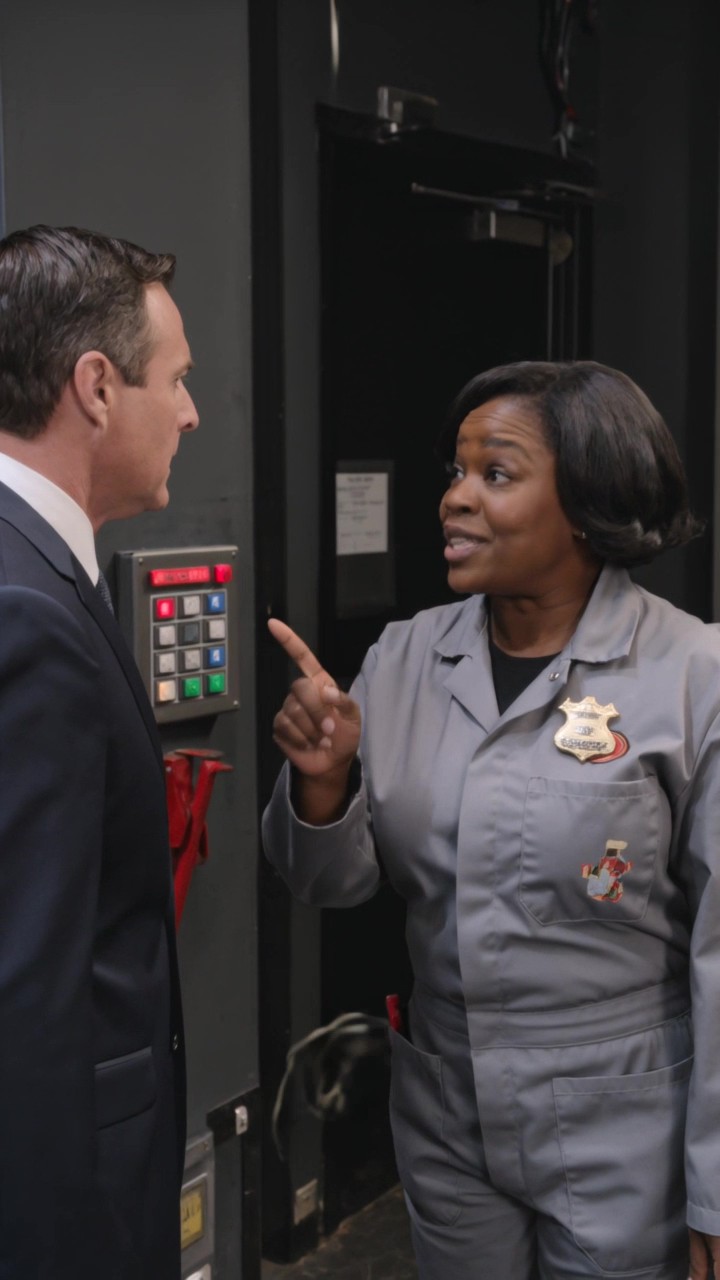
Nora pulled it.
At the safety review, Preston Hale said he believed the curtain itself could have injured performers or damaged equipment.
That was true.
A fire curtain is not a casual pause button.
It must be kept clear.
Nora had checked the curtain line before pulling.
The choir remained in the wing.
No scenery crossed the drop zone.
She chose the only control she knew would stop the children from entering while also forcing every technician to look up.
Preston’s larger failure came after the curtain dropped.
Nora pointed at the cable.
He saw no dramatic break.
The moon still hung.
The audience waited.
The mayor sat in the first row.
Every visible pressure encouraged him to restore normal operation.
He treated Nora’s title as evidence against her observation.
The cable failed before he could reset the curtain.
Investigators examined the broken assembly.
The failure began exactly where Nora had identified the spreading strands.
The wrong retaining pin and angled guide contributed.
The inspection process also failed.
Load tests occurred before final scenery adjustments.
No qualified rigger performed a visual cable check after the last change.
Stagehands were trained to report unusual movement, but costume, cleaning, and front-of-house workers were not included in technical safety briefings.
The theater had created a category of people who spent hours near the machinery yet were expected not to interpret what they saw.
The city’s first public statement praised “the theater’s automated safety systems.”
Nora objected.
“The system did not see it.”
The statement changed.
Then it called her an “unlikely observer.”
She objected again.
“There was nothing unlikely about a former rigger recognizing damaged wire.”
That wording changed too.
Preston was suspended from technical operations.
He had not installed the cable.
He had attempted to override a clear warning without ordering the stage cleared.
The board later reassigned him to programming and donor relations while removing his authority over stage-safety decisions.
Some employees believed dismissal was necessary.
Others believed the theater’s opening-night pressure and weak escalation rules had shaped his response.
Nora said both mattered.
“A person made the choice. A system trained him to fear delay more than doubt.”
The theater replaced every suspension cable in the production.
Final rigging inspection became mandatory after any scenery adjustment.
The fire-curtain area received clearer floor markings.
Any worker could call a technical hold for visible wire damage, unusual mechanical sound, movement, smell, or debris.
No manager could restart until a qualified technician documented the condition.
Workers from costume, cleaning, ushering, and orchestra support joined safety walk-throughs.
The theater also established a rule that safety authority followed the evidence, not the job title.
Nora was offered a ceremonial award and a promotion to wardrobe supervisor.
She declined the promotion.
Wardrobe supervision did not use her rigging experience.
Instead, she accepted paid training to become a stage-safety inspector while continuing part-time costume work.
She needed updated certification.
Modern theater systems differed from shipyard lifting equipment.
Nora did not pretend old expertise made her automatically qualified for every new machine.
She studied.
Failed the electrical-control module once.
Passed later.
The youth choir returned three months afterward.
A replacement moon was built from lightweight translucent fabric over an aluminum frame.
It still required proper rigging.
No object became safe merely because the story had changed.
Before rehearsal, Nora invited the children to stand in the audience while technicians inspected the cables.
She did not show them frightening failure photographs.
She showed them a healthy wire.
Then a retired damaged sample.
One child asked:
“How could you see something so small?”
Nora held up the opened strands.
“Because I knew what small becomes when it is carrying something heavy.”
The choir performed that evening.
No mayor attended.
No television crew.
Parents filled the seats.
Before the final song, the new moon descended smoothly.
Nora stood near the curtain lever.
Preston sat in the back row.
Afterward, he approached her.
“I believed the inspection more than I believed you.”
Nora folded a silver cape.
“No. You believed the inspection more than the new evidence.”
He nodded.
That correction mattered.
Trusting procedures is reasonable.
Treating them as proof that conditions cannot change is dangerous.
The broken cable was mounted in the technical training room.
Not the shattered glass.
The wire.
A plaque beneath it read:
THE LOAD WAS STILL HANGING WHEN THE WARNING BECAME TRUE.
Months later, a front-of-house usher heard a repetitive click near a lighting tower.
She called a hold.
The problem was a loose decorative panel, not a structural failure.
Technicians tightened it.
The show started eleven minutes late.
Nobody mocked the usher.
Nobody removed her badge.
Nora considered that the theater’s real recovery.
The first rescue required one overlooked worker to risk her job.
The safer future began when the next worker needed only to speak.






Leave a Reply