
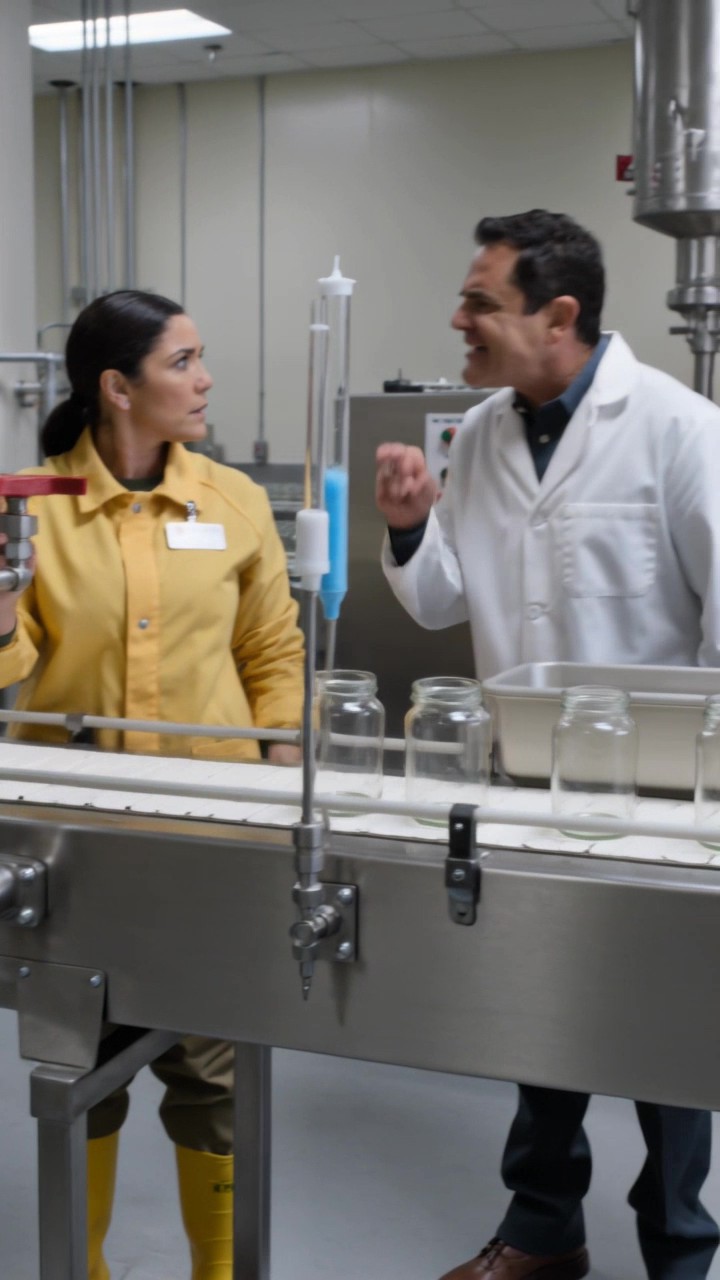
The filling room remained closed for thirty-eight hours.
No contaminated baby food left the plant.
No jars reached a warehouse.
No family opened a product that should never have contained industrial detergent.
That was the good outcome.
The cost was still enormous.
The company discarded a full mixing batch.
It dismantled and flushed the entire rinse system.
A shipment missed its retail deadline.
Two production crews lost overtime.
A grocery contract entered penalty review.
Saving a company does not mean the rescue costs nothing.
It means the cost remains something the company can survive.
Elena Morales had worked nights at Westbridge Nutrition for eleven years.
Her team cleaned tanks, conveyors, fillers, steam tunnels, drains, and the hidden spaces beneath production equipment.
Day managers saw polished stainless steel at the beginning of a shift.
Elena knew what had to happen after the last jar left and before the first jar returned.
Chemicals were color-coded.
Food-safe sanitizer carried a pale green marker.
Floor detergent carried blue.
The actual liquid inside the lines was mostly clear at working concentration.
The color appeared more strongly only when pressure changed or residue collected at a port.
The night before the shutdown, an outside maintenance crew replaced a damaged pump behind the chemical room wall.
Two return hoses had to be removed.
Both were white.
Both used the same size coupling.
The maintenance drawing showed labels that had faded from years of cleaning.
A technician reconnected them according to position.
The hoses had crossed behind a support beam.
Position was not identity.
At 4:42 a.m., Elena began the final rinse verification.
She noticed a sweet chemical smell near the filler room.
Then a faint blue pulse in the inspection tube.
The production supervisor told her startup steam sometimes pulled old color through the line.
Elena had never seen that pattern.
She followed the hose route.
The coupling carrying the blue stripe led toward the food-contact system.
The correct coupling sat on the floor-detergent return.
The baby-food line was minutes from opening.
Elena pulled the emergency valve.
At the review, Preston Hale argued that any employee could claim a smell and interrupt production.
“Operations cannot run on personal impressions.”
Elena placed two sealed sample bottles on the table.
One contained approved sanitizer.
One contained the fluid collected after the shutdown.
“Smell them.”
The company attorney refused.
The laboratory did not need smell.
Testing confirmed the rinse line contained the wrong alkaline detergent at a concentration capable of contaminating the product-contact surfaces.
The internal system had failed at several points.
Maintenance used interchangeable connectors.
Labels were damaged.
The post-repair checklist confirmed pressure but not chemical identity.
The production team began startup before sanitation signed final release.
And when Elena raised the warning, her job title made managers treat evidence as instinct.
Preston had not switched the hoses.
He had ignored the person most familiar with what came through them.
The company initially drafted a public statement praising its “advanced internal monitoring.”
Elena objected.
“The monitor did not stop the line.”
The communications director rewrote the sentence:
A sanitation employee identified an abnormal odor and color pattern before production began.
Elena objected again.
“Use my name.”
The company had no problem using Preston’s name in leadership announcements.
It hesitated to name an hourly worker because lawyers worried the statement could imply an individual had authority beyond procedure.
That was precisely the problem.
Elena had acted beyond the authority managers believed she had because the written procedure required a supervisor to approve a shutdown unless fire, gas, or immediate injury was visible.
Chemical contamination was not listed.
The board opened an independent food-safety review.
The review concluded Elena’s action prevented a probable large-scale recall and severe damage to the company’s retail contracts.
It could not calculate exactly how many jars would have been affected.
It did calculate what a national recall, legal claims, lost trust, and suspended production might have cost.
The estimate exceeded the company’s available insurance and credit.
Westbridge Nutrition might not have survived.
The company did not hand Elena a dramatic executive title.
It first had to repair what had happened on the floor.
Her badge was restored.
She received back pay for the suspension period.
The written warning for “unauthorized shutdown” was removed.
Preston lost direct authority over sanitation release and moved into a planning role during the review.
Months later, he resigned.
Some employees considered that too easy.
Others believed he had been shaped by a bonus system rewarding shipment timing and penalizing delays.
Elena believed both could be true.
“He made the decision,” she said. “The company kept teaching managers what decision it wanted.”
The system changed.
Sanitation release became mandatory before startup.
Any sanitation worker could stop a food-contact line for odor, color, residue, pressure, or labeling concerns.
Interchangeable chemical couplings were replaced with physically incompatible fittings.
Two people verified every post-maintenance reconnection.
A photographed hose map became part of the shift record.
And safety delays were removed from individual production bonuses until an investigation determined whether the concern lacked basis.
The company offered Elena a place in quality assurance.
She accepted only after negotiating that two members of her night team receive paid certification training too.
“I was not the only person who knew the line,” she said. “I was the person closest to the valve.”
That distinction mattered.
The sanitation crew had reported faded labels months earlier.
A day mechanic had requested connector changes.
A purchasing delay left the old fittings in place.
The rescue belonged to one visible action and many ignored warnings.
Elena completed a food-safety credential at night.
Technical English slowed her.
She failed one exam module.
Passed it later.
She became a sanitation verification lead, splitting time between the floor and the laboratory.
She refused to move entirely into an office.
“Samples look different after someone has already cleaned the evidence away,” she told new managers.
One year later, the plant held an employee meeting.
The company president presented a polished silver award.
Elena accepted it, then asked for the red emergency valve handle to be placed in the training room instead.
The handle had been replaced during the system upgrade.
A plaque beneath it read:
THE LINE WAS STOPPED BY THE PERSON WHO KNEW WHAT CLEAN SHOULD SMELL LIKE.
During the next maintenance shutdown, a newly hired sanitation worker noticed a coupling label facing the wrong direction.
She stopped startup.
The connection was correct.
The label had simply rotated.
Nobody mocked her.
Nobody removed her badge.
The crew checked, documented, and restarted twenty minutes later.
That small delay was the proof the company had learned something.
A safety system is not successful only when the warning is right.
It is successful when people are allowed to check without gambling their job.
Elena returned home after the first corrected shutdown and told her husband:
“They stopped the line for nothing.”
He looked worried.
She smiled.
“No. They stopped it long enough to know.”
The company survived because one worker pulled a valve.
It became safer only when the next worker no longer needed courage to do the same thing.







Leave a Reply