
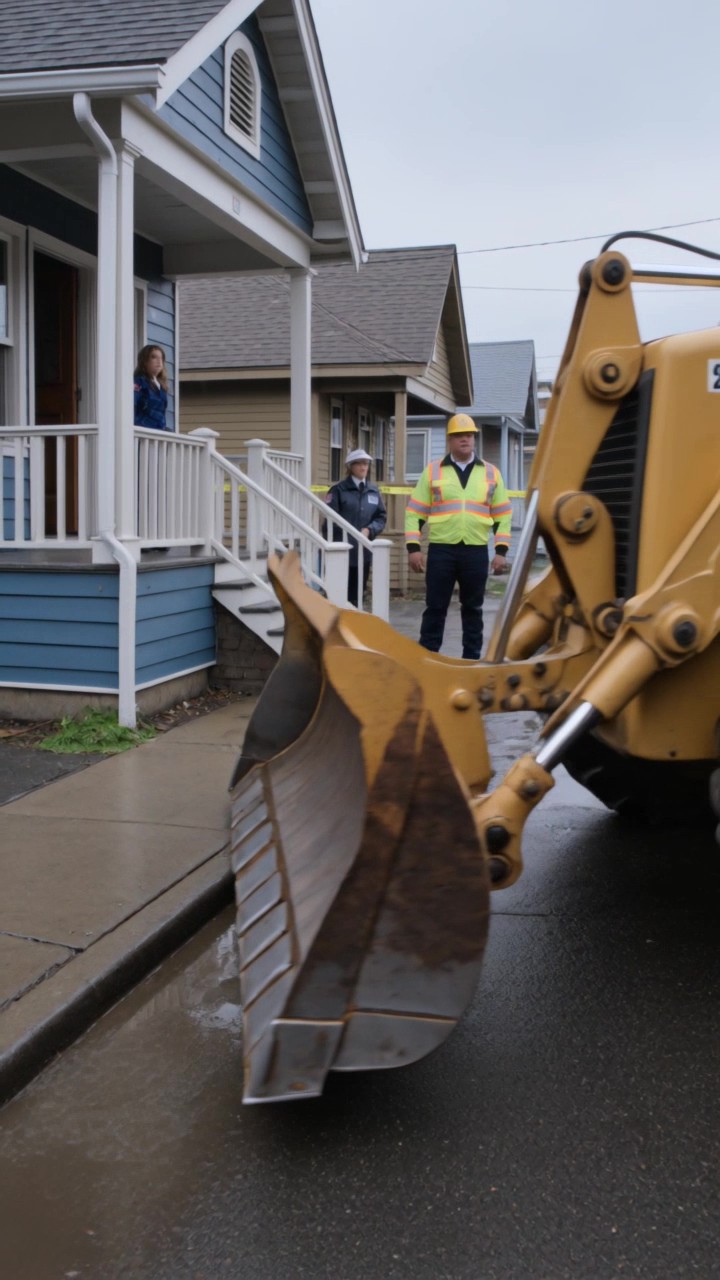
The demolition did not continue.
The city inspector ordered both properties secured until the lot boundaries could be verified.
Margaret Bell remained behind the police tape holding the bulldozer keys.
Her home was small.
Blue siding.
White porch rail.
One crooked window installed by her late husband.
Nothing about it looked valuable enough to stop a city crew.
That was part of the danger.
The vacant structure next door had burned eight months earlier. Its roof was open. Windows were boarded. The city issued an emergency demolition order after bricks fell into the alley.
During fire cleanup, temporary workers removed both ceramic house-number plaques so damaged siding could be cleared.
When the plaques were reattached, they were reversed.
The blue 216 tile made by Margaret’s husband was placed on the vacant house.
A newer metal 218 plate was placed on Margaret’s occupied home.
Later, the vacant house’s metal plate fell and was propped near the wrong porch.
Over time, mail carriers and utility workers relied on occupant names rather than the displayed numbers.
The error remained invisible until the demolition crew arrived.
The official work order included a small exterior photograph.
It showed boarded windows and a burned roof.
The contractor’s packet also listed the physical location using an outdated lot map.
Rain obscured the vacant house from the approach lane.
Preston focused on the displayed number and the deadline.
Jonah looked down.
Before operating heavy equipment, he always checked utility shutoff points.
He had spent nine years working on city water lines before becoming a demolition operator.
Street addresses could change.
Utility lot stamps rarely did.
The cap beneath the bulldozer read 218.
The demolition order was for 216.
That mismatch saved Margaret’s house.
But stopping the machine was only the beginning.
The city’s first response was to call the incident a “numbering discrepancy.”
Margaret objected.
“A discrepancy is when a package goes to the wrong porch.”
She pointed toward the bulldozer.
“That is a house-ending mistake.”
Her anger mattered.
Officials preferred language that reduced responsibility because the building remained standing.
No actual demolition occurred.
No injury.
No lawsuit yet.
But Margaret had watched a steel blade approach the porch where her husband taught their sons to tie shoes.
She spent the previous night removing photographs because a notice on the door told her she had twenty-four hours to vacate an unsafe structure.
She had called the demolition office six times.
Each time, someone told her the order was final.
The system did not fail only when the machine arrived.
It failed every time her voice was treated as confusion because she was seventy-one, lived alone, and could not explain lot numbers using professional terms.
Jonah’s refusal made people reopen what Margaret had already challenged.
The survey confirmed her home occupied Lot 218.
The condemned structure was Lot 216.
The demolition order was corrected.
The vacant house came down two days later.
This time Jonah did not operate the machine.
Preston had terminated him on the spot for refusing a direct instruction.
The contractor upheld the dismissal while the city investigation continued.
Its attorney argued that operators could not independently override marked demolition orders.
Jonah answered:
“Then why require us to inspect utility locations before starting?”
The hearing revealed a conflict.
Operators were responsible for avoiding gas and water lines.
They were not explicitly authorized to stop work over an address inconsistency unless a supervisor agreed.
Jonah had discovered evidence the supervisor chose to ignore.
Following the order would have protected his job and destroyed the wrong house.
The city suspended the contractor from emergency demolition work.
An independent review found several safeguards missing:
No final occupant check.
No same-day comparison between the demolition photograph and the actual structure.
No verbal confirmation with utility services.
And no procedure to pause work after a resident disputed the address.
Preston had not moved the number plaques.
He did choose schedule over contradiction.
He lost his supervisory role.
The contractor offered Jonah reinstatement.
He refused the first offer because it required him to sign a statement saying the event resulted from “shared confusion.”
Margaret attended the meeting.
“There was no shared confusion,” she said. “He knew enough to stop. You knew enough to threaten him.”
The contractor revised the statement.
Jonah returned only after operators received written stop-work authority for address, occupancy, utility, or structural mismatches.
No penalty could be issued until an independent check occurred.
Demolition crews had to photograph utility stamps, lot markers, and all visible sides of a building immediately before work.
Occupied-neighbor contact became mandatory.
Margaret received compensation for the forced hotel stay, damaged garden fence, and the emotional harm caused by the wrongful notice.
She used part of it to repair her porch.
She offered Jonah money.
He declined.
She returned the bulldozer keys instead.
Attached to the ring was a small blue ceramic tag made from leftover tile.
It read:
LOOK DOWN BEFORE YOU TEAR DOWN.
Jonah kept it.
The city wanted to place Margaret’s original 216 plaque in a training display.
She refused.
“My husband made it for the house.”
The blue number returned to the correct porch.
Below it, she added a smaller tile:
LOT 218.
Not attractive.
Useful.
One year later, another operator found a mismatch between a demolition order and a gas-meter location.
He stopped.
The supervisor complained.
The written policy protected him.
The lot was checked.
Again, the order was wrong.
This time no widow had to stand in front of a machine.
Margaret learned about the second incident through the local paper.
She called Jonah.
“You started something.”
He looked at the blue tag on his key ring.
“No.”
“You argued first.”
That was the truth.
Margaret had called six times before he arrived.
Jonah did not save a silent woman.
He was the first worker with control of the machine who treated her warning as information.
Her home remained.
Not as a reward.
Because the person holding the ignition keys understood that employment could be replaced more easily than a house destroyed by obedience.







Leave a Reply