
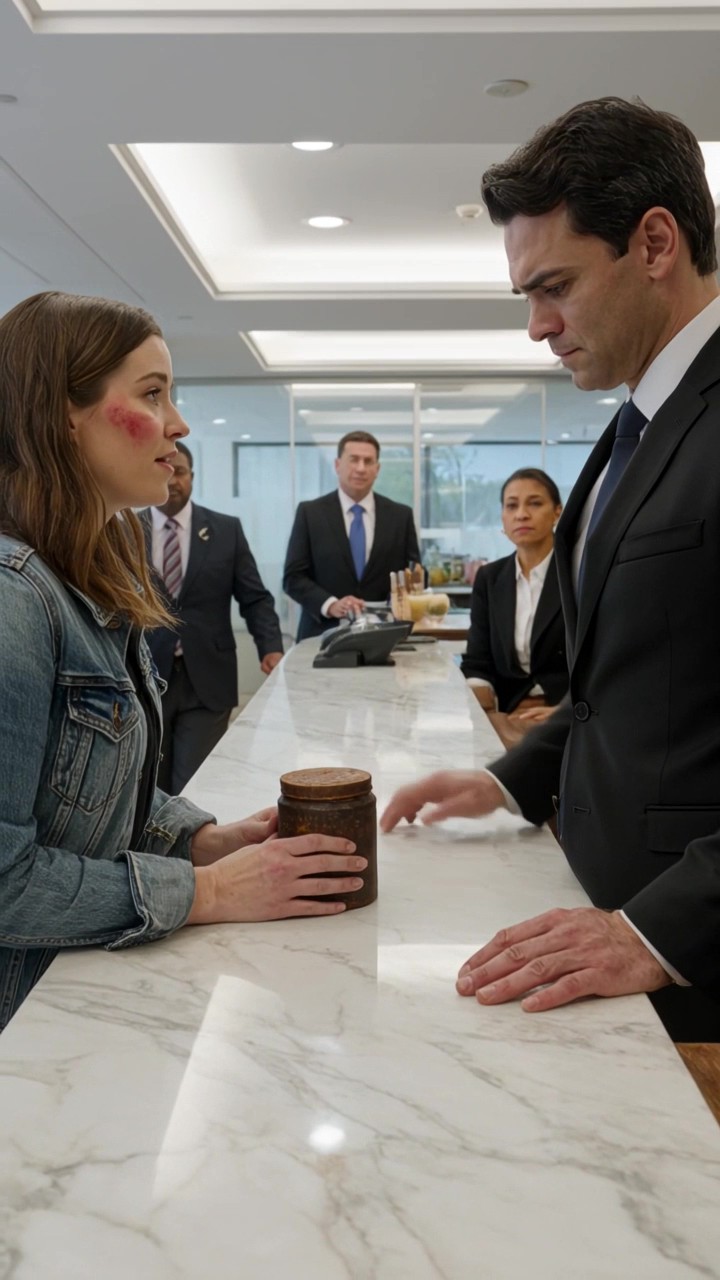
Preston Vale lifted his foot from the brass tag.
Too late.
Everyone had seen it.
Eleanor Brooks walked across the lobby slowly, leaning hard on her cane.
Her eyes stayed on the wheat seeds scattered across the marble.
“Do not sweep those,” she said.
The janitor froze with his broom half-raised.
Clara Miller stood still, one cheek red, both hands clenched at her sides.
Eleanor bent with effort and picked up the brass tag.
MILLER WHEAT — FLOOD YEAR.
Her hand trembled.
“I was nine years old when your grandfather came through that door soaked to the bone.”
Clara’s voice broke.
“You knew him?”
Eleanor nodded.
“Samuel Miller. He arrived during the 1978 flood with two sacks over his shoulders. One held wheat seed. The other held our vault ledgers.”
The lobby became silent in a new way.
Not scandal silence.
Reverence.
Eleanor faced the clients.
“The river breached the lower district. Harbor Trust’s basement flooded. Our bank records were stored in paper ledgers then. The staff evacuated too late. Samuel Miller used his tractor to reach the rear entrance, carried the ledgers out through chest-deep water, then went back for his seed.”
Clara closed her eyes.
“My grandmother said he almost drowned.”
“He did,” Eleanor said. “My father credited him with saving the bank’s legal history.”
Preston whispered, “I didn’t know.”
Clara looked at him.
“You didn’t need to know him to not step on his tag.”
Eleanor opened the note.
Her face hardened as she read.
“This is not a family myth. This is a water rights covenant tied to the Miller Land Trust. Harbor Trust agreed never to transfer the creek access without Miller family consent, in exchange for Samuel’s emergency recovery of bank records.”
Clara let out a breath.
“So it exists.”
“Yes,” Eleanor said. “And if your farm is being auctioned with those water rights bundled, someone is violating that covenant.”
Preston’s face turned gray.
Eleanor looked at him.
“Who handled the auction packet?”
He said nothing.
That was enough to begin the investigation.
Within two hours, the sale was frozen.
By evening, legal review found that the farm’s creek access had been quietly attached to a development proposal. Preston had expedited the packet for a client group hoping to build a resort on former farmland.
Clara sat in a conference room with wheat seeds in a paper cup because the jar lid had broken.
Eleanor joined her, carrying a new glass jar from the bank archives.
“My father kept this empty on his desk for years,” she said. “He said it reminded him banks survive only because other people trust them with more than money.”
Clara poured the seeds into the new jar.
“My father thought nobody would listen.”
Eleanor’s face softened.
“We listened late. That is not the same as listening well.”
The Miller Land Trust was restored.
The farm auction was canceled.
Preston was removed and referred for legal review.
Harbor Trust created a public archive display in the lobby. At the center sat the wheat jar, the brass tag, and a photo of Samuel Miller standing beside his mud-covered tractor in 1978.
The plaque read:
Before this bank protected wealth, a farmer protected its word.
Clara’s father lived long enough to see a photo of the display.
He touched the picture with one finger and whispered, “Dad was right.”
Clara smiled through tears.
“About what?”
“Seeds remember where they belong.”
The farm survived.
Not untouched.
Not magically saved from every debt.
But alive.
The wheat field by the creek was replanted the next spring.
Eleanor came to the farm opening in boots, not heels.
Clara handed her a handful of seeds.
“Careful,” Clara said.
Eleanor nodded.
This time, the bank understood exactly what it was holding.






Leave a Reply