
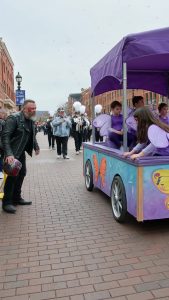
Main Street went silent.
The rear corner of the float rested crooked against the bricks. Painted flowers snapped. One butterfly wing lay under the broken rail.
Emma stared at the place where she had been sitting.
Her mother’s phone hung uselessly in her hand.
Mason Reed stood by the barricade with a red mark on his cheek and his eyes still on the children, counting them silently.
One.
Two.
Three.
Four.
Five.
Six.
Seven.
All standing.
All crying.
All alive.
Deputy Chief Helen Morris crouched near the wheel assembly.
“Bearing failure,” she said. “This was not sudden.”
The parade marshal Preston swallowed.
“We inspected the float this morning.”
Mason looked at him.
“You inspected decorations. Not the axle.”
Helen glanced at Mason.
“You saw it from the curb?”
“I heard it first.”
Vivian turned slowly.
“You saved her.”
Mason looked at Emma.
“She was leaning over the bad corner.”
Emma nodded, crying now.
“He said stop.”
Vivian’s face crumpled.
“I thought—”
“I know what you thought,” Mason said.
The sentence was not cruel.
It was tired.
People had thought things about him for years.
Because of the jacket.
The beard.
The tattoos.
The motorcycle.
They never saw the man who had spent twenty years fixing trailers, volunteering at accident scenes, and checking bolts on school festival rides because he could not unremember the day a wheel failed in front of him.
Deputy Chief Helen stood.
“Mason Reed used to build parade rigs for the county fair. After the 1999 accident, he helped rewrite float safety rules.”
Preston stared.
“That was you?”
Mason shrugged.
“Was.”
Helen looked at Preston.
“And you ignored him because he looked inconvenient.”
The crowd shifted.
Vivian stepped toward Mason.
“I am sorry.”
Mason touched his cheek once.
“Teach her to listen when someone says move.”
Vivian nodded, tears on her face.
“I will.”
Emma walked to Mason slowly.
Vivian almost stopped her.
Then did not.
Emma held out the silver paper crown.
“You can have this.”
Mason looked at the crown, then at the broken float.
“I don’t need a crown.”
Emma sniffed.
“You were the only one watching the wheel.”
That broke the crowd more than any speech could.
Mason took the paper crown gently.
“Then I’ll keep it safe.”
The parade was canceled.
Some people complained for five minutes.
Then the second inspection found two more floats with loose fasteners, overloaded frames, and decorative panels hiding structural problems.
The town changed its parade rules that week.
No float could roll without mechanical inspection by certified volunteers.
Any person, even a bystander, could call a stop if they saw a safety risk.
And Mason Reed was asked to lead the new inspection team.
He said no.
Then Emma’s hand-drawn thank-you card arrived at his motorcycle shop.
It showed a biker with a paper crown standing beside a parade float with very large wheels.
Inside, in crooked letters, she wrote:
Thank you for being scary to the wheel.
Mason laughed until his eyes watered.
He accepted the job.
One year later, at the next parade, Mason walked the route before sunrise, checking every wheel, hitch, rail, and brake line.
No cameras followed him.
No one cheered.
That was fine.
Safety does not need applause.
Near the town square, a small sign was added to the parade staging area:
Listen to warnings before they become accidents.
Mason kept Emma’s paper crown on a shelf in his workshop, beside torque wrenches and old safety manuals.
Every time someone asked why a biker had a child’s crown near his tools, he said:
“Because one day, looking dangerous was less important than seeing danger first.”




Leave a Reply