
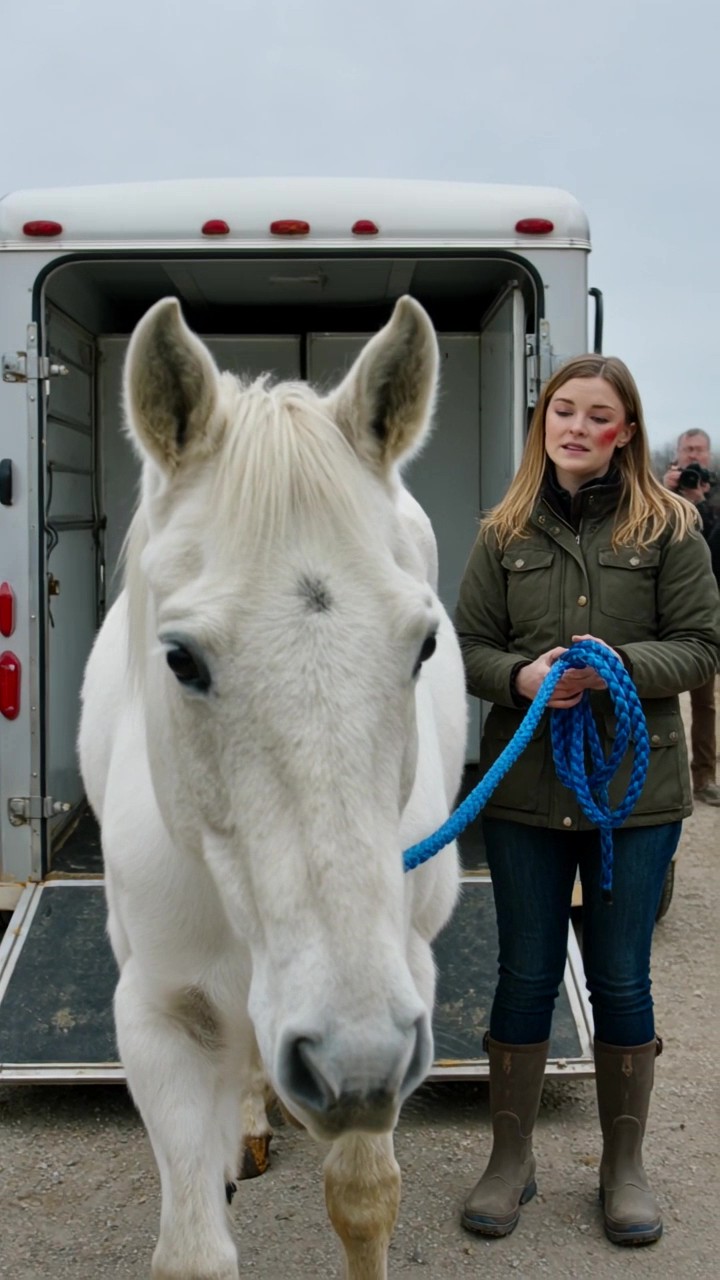
The auction yard went silent.
Apollo, or Sunday, stood with his forehead pressed into Rose’s shoulder.
The horse was no longer shaking.
Rose held the blue rope against his neck with one hand and wiped her cheek with the other.
Charles Whitman looked humiliated.
Vivian Hart looked terrified.
Dr. Henry Brooks walked toward the horse slowly, letting Sunday smell his hand first.
“Hello, old boy.”
Sunday blew warm air against his sleeve.
Charles snapped, “I purchased this horse legally.”
Dr. Brooks turned.
“You purchased an animal from a program that failed to disclose care conditions, attachment history, and working-handler dependency.”
Vivian said quickly, “The paperwork states he was therapy trained.”
“Therapy trained does not mean emotionally blank.”
Rose looked at Dr. Brooks.
“You knew he was being sold?”
His face softened with guilt.
“I was told he was being retired to a quiet home with his handler involved. Not auctioned for cameras.”
Charles’s daughter Madison looked at Rose.
“He likes you.”
Rose gave a small sad smile.
“He trusts me.”
Madison lowered her eyes.
That was the difference.
Like and trust can look similar from far away, but animals know.
Dr. Brooks faced the crowd.
“This horse helped children speak after trauma. He stood still for veterans during panic attacks. He lowered his head for patients who could not lift their arms. Rose Miller was his primary handler for six years.”
Charles looked at Rose differently now.
“You were paid staff?”
Rose nodded.
“Barely.”
Vivian said, “The program closed. We had no funding.”
Rose’s voice broke.
“I offered to keep him at the old barn until we found a sanctuary.”
Vivian avoided her eyes.
“Sanctuaries cost money.”
Charles looked at Sunday.
“And my estate has money.”
Dr. Brooks said, “Then use it correctly.”
Charles frowned.
“What does that mean?”
Madison answered before anyone else could.
“It means don’t take him away from her.”
The crowd looked at the girl.
She stepped toward her father.
“I wanted a horse with a story. She is his story.”
Charles swallowed.
For the first time that day, he looked like a father instead of a buyer.
Rose stroked Sunday’s cheek.
“I’m not trying to take what you paid for.”
Dr. Brooks said, “No. But we can restructure this.”
Within an hour, the sale was suspended. Charles agreed to fund the reopening of the county therapy barn under a nonprofit partnership. Sunday would remain at the barn with Rose as lead handler, and Madison could volunteer if she learned the rules from the ground up.
Vivian was removed from the charity board after records showed she had rushed the sale to cover program debt while ignoring animal welfare recommendations.
Sunday did eventually step into the trailer.
But only after Rose walked in first with the blue rope.
Not to leave forever.
To go home to the old barn.
The barn reopened three months later.
Its first therapy session was not glamorous.
No cameras.
No donors.
Just a little boy who had not spoken since his house fire, sitting on a wooden bench while Sunday stood nearby.
Rose did not push.
Sunday did not move.
After twenty minutes, the boy reached out and touched the horse’s neck.
“Warm,” he whispered.
His mother cried.
Madison, now wearing muddy boots instead of riding clothes, cleaned stalls quietly in the back.
Charles watched from the fence.
He had paid for many things in his life.
This was the first time he understood that money could protect love only if it stopped trying to own it.
Near Sunday’s stall, Rose hung the blue rope on a brass hook.
Under it was a small sign:
Trust is not bought. It is returned.
Every morning, Sunday touched the rope with his nose before walking into the arena.
And Rose, who had once been slapped for loving what she could not afford, became the person the whole county called when a frightened animal—or child—needed to remember where safe was.



Leave a Reply