
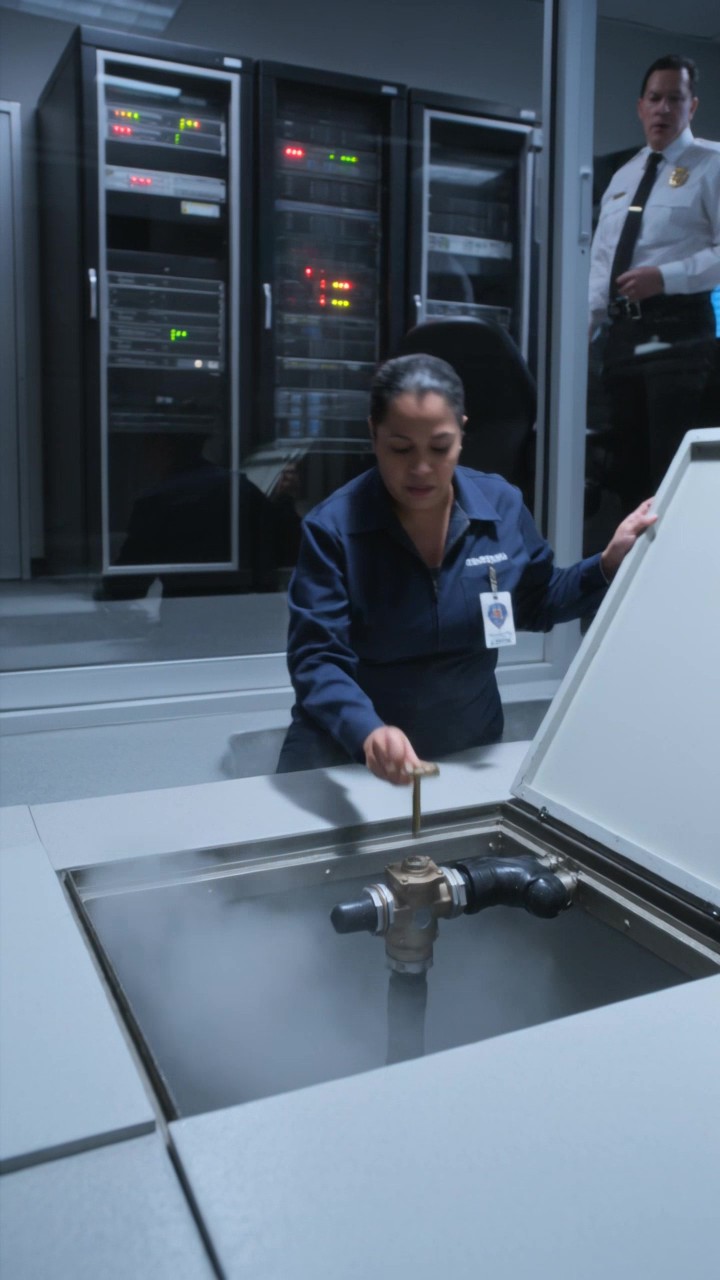
The Westbridge Emergency Communications Center never stopped answering calls.
That was the fact that mattered most.
Dispatchers switched to secondary mapping for forty-three minutes.
Police and ambulance routing slowed slightly.
No call center likes the word slightly during an emergency.
But the city did not lose voice service.
The servers did not short.
The powered channels beneath Row C remained dry because Ana Morales had isolated the main chilled-water flow before the coupling failed.
Facilities engineers arrived at 2:39 a.m.
They removed three more floor panels.
The fracture was obvious now.
The pipe support had shifted after recent building work. The coupling had carried uneven pressure for weeks. Vibration wore the joint until only a thin band held it together.
One engineer looked at Ana.
“How did you hear it over the server fans?”
She answered honestly.
“I clean when everyone else stops talking.”
The dispatch supervisor Vivian Hart stood beside her.
Preston Hale had been sent to change his soaked clothes.
He returned wearing an emergency jacket and a different expression.
Not humility yet.
Mostly fear.
A city administrator joined by video conference and asked who authorized the shutdown.
Preston looked at Ana.
Ana looked at the flooded aisle.
“I did.”
The administrator frowned.
“You are facilities staff?”
“Night cleaning contractor.”
Silence followed.
The kind of silence institutions create when the wrong job title does the right thing.
Preston stepped forward.
“She interfered with critical infrastructure without authorization.”
Vivian turned toward him.
“And prevented the coupling from releasing the entire loop.”
“We cannot allow untrained contractors to shut systems down.”
Ana looked at the brass key on her cart.
“I agree.”
Everyone turned to her.
She continued.
“I should not have been the only person who heard the pipe, the only person answering the maintenance phone, and the only person willing to close the valve.”
That changed the argument.
Ana did not want a medal for breaking hierarchy.
She wanted to know why hierarchy had left her alone with a failing pipe beneath a 911 center.
The investigation found several failures.
The overnight facilities call had been routed incorrectly after a software update.
A vibration report from the previous week had been closed as “environmental noise.”
Cleaning workers were forbidden from entering maintenance observations into the building system, even though they spent more hours near floors, drains, ceilings, and utility rooms than many daytime managers.
The contractor training told cleaners to report water.
It did not tell them what to do when water was seconds away from reaching power.
Preston had not caused the damaged coupling.
But he had nearly converted a contained leak into a center-wide failure because restoring normal operation felt more defensible than trusting Ana.
He was removed from emergency infrastructure supervision.
Vivian stayed.
She requested that Ana participate in the review.
Ana agreed on one condition.
“No ceremony before the procedure changes.”
The city wanted a photograph.
A cleaner with a brass key beside grateful dispatchers.
Ana refused.
“My father taught me systems do not improve because someone says thank you after they almost ignore you.”
The new policy took six weeks.
Night cleaners, guards, custodians, and delivery staff received a direct emergency maintenance channel.
Utility shutoff points were clearly marked.
Any worker who observed immediate risk could isolate a local system if delay threatened life-safety infrastructure.
The action triggered review, not automatic punishment.
More importantly, the city created a pathway for workers with foreign technical experience to document skills and enter paid certification programs.
Ana passed her state exam eight months later.
She became an assistant facilities engineer at the same emergency center.
Her salary increased.
Her uniform changed.
The brass key did not.
She mounted it beside Row C in a small open box, available to trained staff.
Not behind glass.
A tool should remain usable.
Under it, a metal label read:
PIPES SPEAK BEFORE THEY SPLIT. LISTEN TO THE PERSON CLOSEST TO THE FLOOR.
Preston sent Ana a written apology.
She returned it with one handwritten question:
“What will you do differently when the next warning comes from someone you do not respect yet?”
He answered months later.
He had accepted a lower-level operations role at a hospital complex and helped add housekeeping staff to safety rounds.
Ana did not forgive him because his career changed.
She accepted that he had finally understood the assignment.
Her father never saw the new job.
He had died years earlier.
But on Ana’s first day as assistant engineer, she called her mother and placed the brass key against the pipe so the sound carried through the phone.
“What is that?” her mother asked.
“A healthy line.”
“How can you tell?”
Ana smiled.
“It has nothing to say.”
At 2:17 every morning, she still walked Row C.
Not because she distrusted the new sensors.
Because technology records what it has been designed to notice.
People notice what experience taught them to fear.
The call center remained full of voices asking for help.
Beneath them, the pipes ran quietly.
And the city finally understood that the woman emptying bins had once been the only person listening to the system that kept every emergency voice connected.







Leave a Reply