
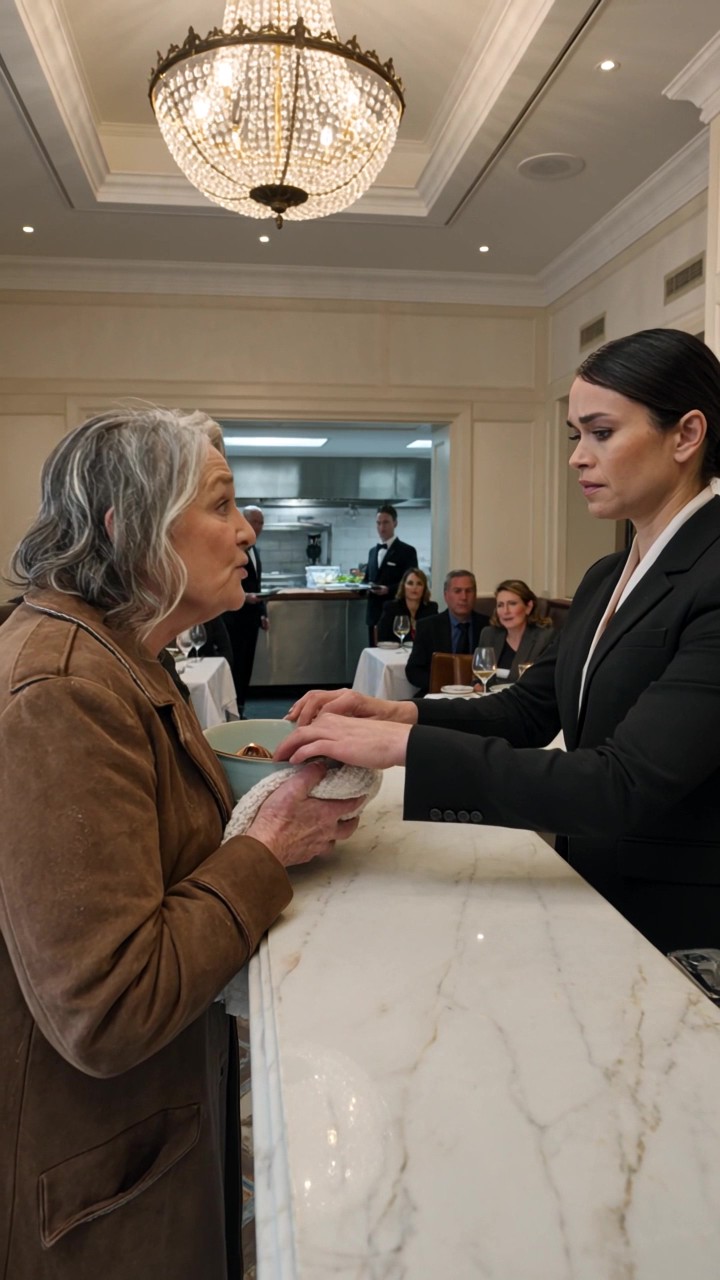
Martha Lane stood very still.
The red mark on her cheek deepened under the restaurant lights.
Chef Adrian Whitmore held the recipe card with both hands, as if a stronger grip could keep the past from falling apart.
The guests watched silently.
Celeste Hart stepped back.
Adrian read the words again.
ADRIAN’S LAST WARM BOWL.
His mother’s handwriting.
The same slanted letters from birthday notes he had kept in a box but rarely opened because grief had teeth.
“What does this mean?” he whispered.
Martha looked toward the open kitchen.
“Your mother came to my apartment the night before she went to the hospital. The gas was off in yours. She had three onions, two pieces of stale bread, and no strength left to stand.”
Adrian’s throat tightened.
“I remember soup.”
“You remember her making it,” Martha said. “But she couldn’t. I held the pot. She told me what to do from a chair.”
The copper ladle lay on the floor between them.
Adrian bent and picked it up.
His hand shook.
Martha continued.
“She burned the bread on purpose because you liked the bitter edge. She said, ‘If he ever becomes a chef, make sure he remembers food is not decoration first. It is rescue.’”
The line struck Adrian so hard he sat down on the nearest chair.
His entire career had been built on that soup without him understanding it.
Caramelized onion foam.
Charred bread dust.
Copper-pot reduction.
Critics had called it elegant.
His mother had called it dinner when there was almost nothing left.
Martha opened the chipped blue bowl. Inside, beneath the towel, was a small sealed jar.
“This is not the soup,” she said. “That would be impossible. It’s the onion seed packet she kept in the drawer. She wanted you to plant something if you ever had a kitchen with windows.”
Adrian covered his mouth.
His restaurant kitchen had no windows.
It had cameras.
It had awards.
It had staff who moved like soldiers.
But no windows.
Celeste whispered, “Chef, I didn’t know.”
Adrian looked at her.
“You didn’t need to know her story to not hit her.”
The sentence dropped like the ladle, bright and hard.
Then Adrian did what no one expected.
He canceled the caviar course.
The maître d’ nearly fainted.
Adrian carried the chipped blue bowl into the kitchen himself. Martha followed slowly, still holding her cheek.
He asked her to stand beside the stove.
She tried to refuse.
“My coat is wet.”
“This kitchen owes that coat more than it owes these jackets,” he said.
Together, they made onion soup.
No luxury version.
Onions sliced thin.
Butter cut small.
Water first, then stock, because Ruth had stretched everything.
Burnt bread on top.
Copper ladle against the pot.
Three taps.
When the bowls went out, the dining room smelled less like wealth and more like an apartment hallway in winter where someone had kept another family alive.
Adrian served Martha first.
She shook her head.
“No. Your mother made it for you.”
So he tasted it.
One spoonful.
Then he wept.
Not loudly.
Not performatively.
A grown man sitting on the kitchen step, holding an old blue bowl, finally understanding that the flavor he had spent years refining had been born from someone else refusing to let him go to bed cold.
After that night, the Grand Alder restaurant changed.
Once a week, before service, the kitchen cooked Ruth’s onion soup for anyone on staff who had missed a meal.
Once a month, the restaurant opened for neighborhood families at no charge, no questions, no photos.
Celeste was dismissed.
The chipped blue bowl was repaired with a visible gold seam and placed near Ruth’s portrait, beside the copper ladle and the onion seed packet.
Under it were nine words:
Before food became art, it kept a child alive.
Adrian later built a small rooftop garden.
Onions grew there first.
Martha came to water them when her knees allowed.
Sometimes Adrian stood beside her in silence.
Sometimes she told him stories of his mother.
How Ruth sang off-key.
How she saved sugar packets for his birthday.
How she said Adrian would one day cook for rooms full of people, but she hoped he would never forget the sound of a spoon touching an empty bowl.
He never forgot again.




Leave a Reply