
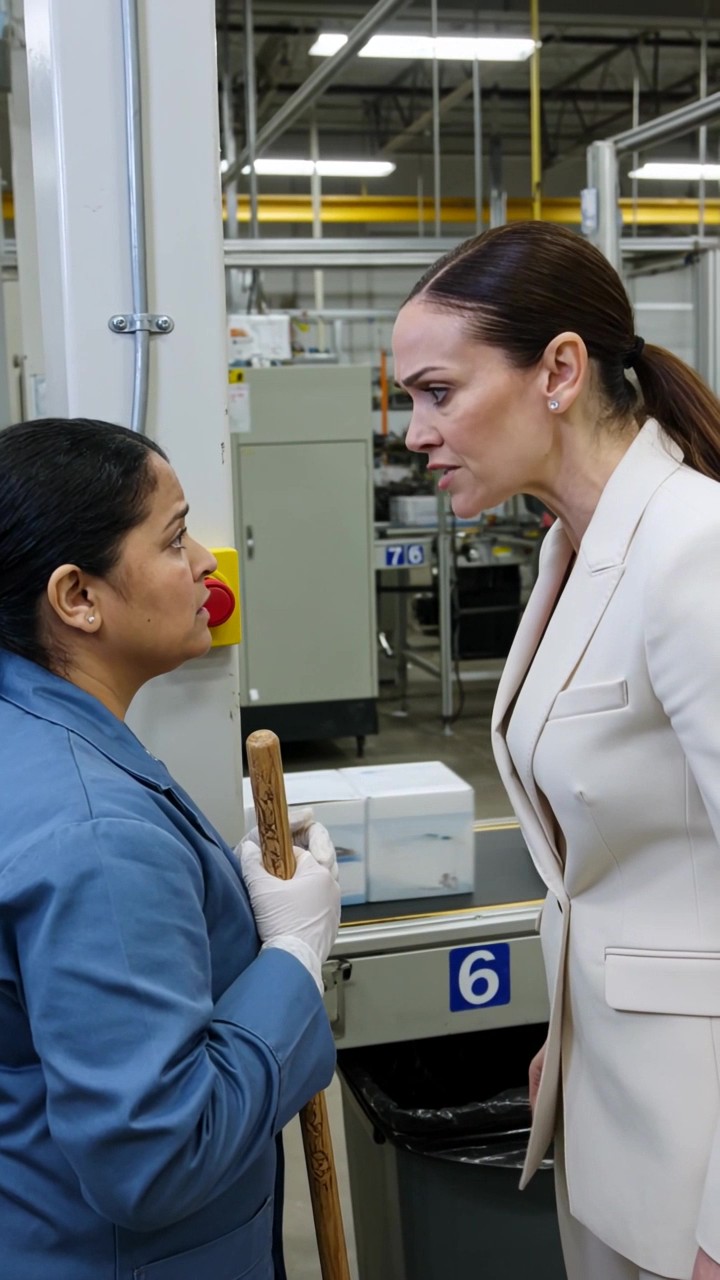
The packaging floor stayed frozen.
The conveyor line was silent now, but the smell of heated plastic hung in the air.
Rosa stood beside her mop bucket with one cheek red and one hand still wrapped around the emergency stop cord.
Dr. Elena Brooks walked to Conveyor 6 and crouched carefully beside the misaligned roller.
No one spoke while she inspected it.
Not Preston.
Not Vivian.
Not the investors.
Elena stood with red dust on her glove.
“This is casing abrasion.”
Rosa nodded.
“Under the roller.”
Elena looked at the swelling battery pack.
“Pull every unit that passed through this line after midnight.”
Preston swallowed.
“That’s thousands of units.”
Elena turned to him.
“Then be grateful she stopped thousands, not millions.”
Vivian tried to recover.
“We had a launch schedule.”
Elena’s voice sharpened.
“Medical devices do not become safe because marketing is ready.”
The investors looked away.
Rosa picked up the cracked mop handle.
Her thumb moved over the carved grip.
Her son had shaped it from scrap wood after her wrist surgery, sanding it smooth because she came home every morning unable to close her fingers.
He had said, “If the job hurts you, at least the handle shouldn’t.”
Vivian saw her holding it and finally looked ashamed.
“I didn’t know.”
Rosa did not look at her.
“You didn’t need to know my son to not mock what helped me work.”
That sentence stayed in the floor longer than the alarm.
Quality control opened the first hundred units.
Thirty-one showed casing damage.
Seven showed heat stress.
One had already split.
The launch was canceled.
BrightLife’s stock price dipped that week.
The company lost money.
But not trust.
Because Elena insisted the truth be announced publicly before rumors wrote it uglier.
“We delayed the launch because a frontline worker noticed a product hazard and used the emergency stop,” the CEO said in a statement. “That is our safety system working, not failing.”
Preston was removed from floor management.
Vivian was placed under review for retaliating against an employee raising a safety concern.
Rosa expected to be fired quietly once the attention faded.
Instead, Elena asked her to join the new Floor Observation Council.
Rosa laughed.
“I mop under machines.”
Elena smiled.
“Exactly. You see what dashboards don’t.”
The company changed its pre-launch inspection process. Cleaners, packers, maintenance assistants, and loading staff were now required to sign off on what they saw at floor level before executive approval.
Rosa’s mop handle was repaired with a metal brace and mounted near Conveyor 6 after she received a new one from her son.
She hated the display at first.
Then a young engineer told her, “I check under rollers now because of it.”
That made her accept it.
Months later, BrightLife relaunched the insulin cooler.
This time, Rosa stood in the back of the room.
Not on stage.
She did not want a microphone.
But when the CEO thanked “the worker who stopped us in time,” the floor staff turned around and looked at Rosa first.
She lowered her eyes, smiling slightly.
Above Conveyor 6, a sign now read:
If the lowest person on the floor sees danger, the whole company looks down.
And every time Rosa swept under that machine, she knew the red dust had been more than debris.
It had been the truth gathering where no one powerful had bothered to look.






Leave a Reply