
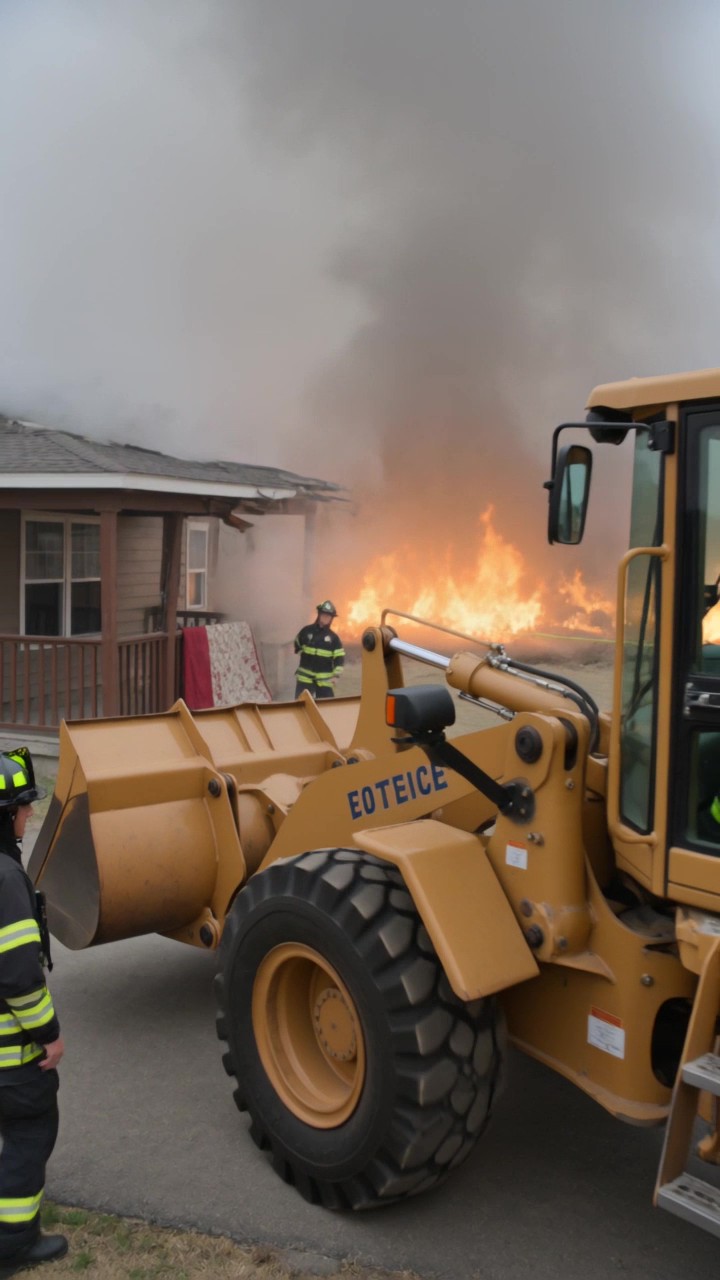
By sunset, the Alder Ridge fire was contained at the edge of the subdivision.
Thirty homes remained standing.
The school gym became an overnight shelter.
The propane tanks never ignited.
News reports called Captain Ethan Cole’s decision “a decisive firebreak intervention.”
Margaret Bell called it the day her house was taken twice.
First by the loader.
Then by people who spoke about the wreckage as if it were only a successful tactic.
She sat on a folding cot in the gym wearing borrowed slippers and refused to speak to Ethan.
He did not ask her to.
The county opened an investigation the next morning.
Ethan had authority to move equipment and protect life, but no clear written rule allowed him to demolish a privately owned home without command approval.
The incident commander had been coordinating evacuations on the opposite side of the ridge.
Radio traffic was overloaded.
Ethan made the decision alone.
Some firefighters supported him.
Others said the loader could have cleared the vacant lot beside Margaret’s house instead.
Ethan had considered it.
The vacant lot was narrower and filled with buried irrigation pipes. Clearing it might have taken five additional minutes.
Five minutes might have been enough.
Or not.
That uncertainty became the center of the debate.
Margaret attended the public review carrying the metal house key she had thrown at the windshield.
The brass was scratched from the impact.
She placed it on the table.
“Everyone keeps asking whether he saved the street,” she said. “He did.”
The room shifted.
Then she continued.
“Nobody asks what happens when the thing sacrificed belongs to one person and the benefit belongs to everyone.”
Ethan looked down.
Margaret described the house room by room.
The pencil marks recording her sons’ heights.
The kitchen cabinet her husband built crooked.
The red quilt stitched from his work shirts.
Photographs had been removed during evacuation.
Many small things had not.
A house is not only its most valuable objects.
It is also the pattern of where a cup always sat.
The loose stair that announced someone coming home.
The window that caught winter light.
Ethan did not defend the loss with numbers.
He said only:
“I chose your property because it offered the fastest barrier between the fire and the tanks.”
Margaret asked, “Would you have chosen your own?”
He answered honestly.
“I do not know.”
That answer angered some residents.
They wanted certainty from the man they were calling a hero.
Margaret appreciated it more than a rehearsed yes.
The review concluded that Ethan’s action likely prevented wider fire spread, but emergency demolition policy was dangerously unclear. He received no criminal penalty, but he was removed from field command for six months while the department revised procedures.
The county’s insurer initially claimed Margaret’s fire coverage did not apply because the main structural damage was intentional.
That sentence nearly broke the community’s gratitude apart.
People who had thanked Ethan realized the system might leave Margaret to carry the full cost of saving them.
Residents organized legal support.
The school opened its records.
Fire-behavior specialists testified that the demolition formed the decisive break protecting the propane area.
After months of dispute, the county created a compensation settlement using emergency funds, insurance contributions, and donations from the protected neighborhood.
It paid for a new house.
It did not return the old one.
Margaret refused to rebuild on the same footprint.
She chose a smaller home across town with one level and a garden facing east.
Ethan offered to help move furniture.
She said no.
He accepted it.
Weeks later, a cleanup volunteer found a square of red fabric beneath a fallen porch beam.
Most of the quilt was gone.
The surviving piece contained part of a blue work-shirt pocket and three lines of Margaret’s hand stitching.
The volunteer gave it to Ethan, assuming he should present it publicly.
He refused.
He placed it in an envelope and mailed it to Margaret without a note.
She knew who had sent it.
The fabric sat unopened on her table for nine days.
Then she used it to make a small cover for the scratched house key.
She did not call Ethan.
Not then.
The new emergency policy required three safeguards:
When time allowed, incident command approval was mandatory.
Property sacrifice had to be documented against viable alternatives.
And compensation planning began the same day as the emergency action—not months later after public pressure.
The final rule mattered most to Margaret.
If the public benefits from one person’s loss, the public inherits responsibility for the repair.
Ethan returned to field command after training.
He never used the word heroic about Alder Ridge.
During new captain classes, he showed aerial photographs of the firebreak and then placed an empty chair at the front of the room.
“That chair belongs to the person whose property your map turns into a tactical option,” he said. “Make the decision if life requires it. But never erase who pays.”
One year after the fire, the neighborhood held a reopening picnic at the school gym.
Margaret attended.
Ethan stood near the exit, prepared to leave without approaching her.
She walked over and placed the old key in his palm.
The surviving quilt fabric covered its sharp edge.
“I do not forgive the house,” she said.
Ethan nodded.
“You do not have to.”
“I understand the fire.”
He closed his fingers around the key.
“That is more than I expected.”
Margaret took it back.
The key opened nothing now.
She still kept it.
Understanding did not require surrendering the right to grieve.
The street survived because Ethan chose one property to destroy.
Margaret survived the story only after the town stopped asking her to celebrate that choice.







Leave a Reply