
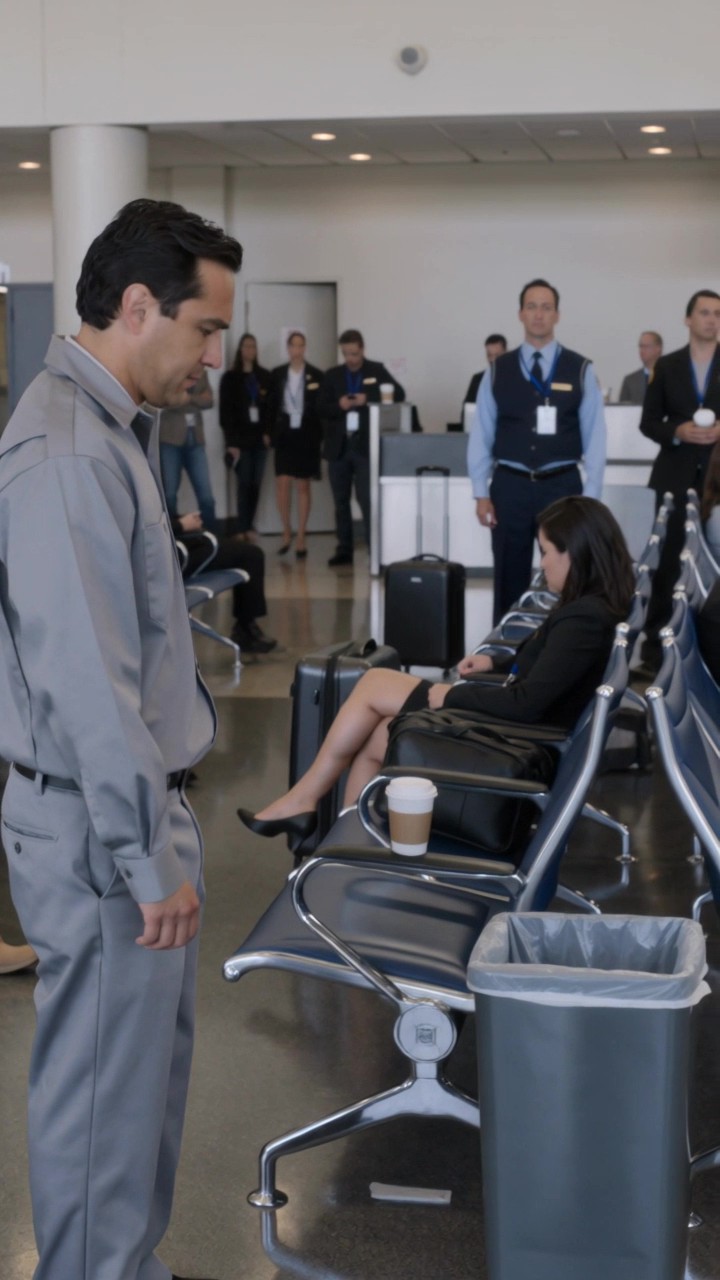
The six cups were found before anyone drank enough to become seriously ill.
Two passengers had taken small sips and were evaluated by airport medical staff.
The flight was delayed.
The coffee stand closed immediately.
Luis’s daughter, Ana, had been working her third week at the stand.
That morning, two clear bottles had been left beside the sink.
One contained syrup-rinse water.
The other held diluted sanitizer used for cleaning equipment.
The labels had peeled off after repeated washing.
Ana grabbed the wrong bottle while preparing a batch of cold drinks.
She realized the smell was wrong only after several cups had already gone out.
She found Luis near the gate and told him what happened.
Ana begged him not to report her directly.
Her mother had been out of work for months.
Ana’s paycheck was helping cover rent.
Luis made the wrong first choice.
Instead of calling the airport safety desk immediately, he tried to find the cups himself.
He thought he could quietly stop the passengers before anyone knew Ana had made the mistake.
But Rebecca would not listen.
The flight crew did.
That saved time.
It also exposed the truth.
Inside the airport operations office, Ana admitted everything.
Luis admitted he had delayed reporting the issue for several minutes to protect her.
Maya, the flight attendant, remained as a witness.
“You protected your daughter,” she told him, “but you also left five passengers holding unsafe drinks while you tried to solve it alone.”
Luis nodded.
“I know.”
Ana was suspended pending review.
The stand supervisor was also suspended after investigators found unlabeled bottles had been reported twice before and ignored.
Airport management confirmed that employees had complained about rushed closing procedures and missing labels.
The mistake had been Ana’s hands.
The system had made it easier for the mistake to happen.
Rebecca, the passenger whose coffee Luis threw away, later gave a statement.
She did not soften what happened.
“He grabbed my drink without explaining. It scared me.”
Then she added:
“But if he had not done it, I would have kept drinking.”
Luis kept his job after a formal warning for delaying the safety report.
Ana lost her position at the coffee stand but was not banned from future airport work. The investigation concluded that she had panicked, then attempted to correct the mistake by telling her father instead of fleeing entirely.
That distinction mattered.
A week later, Luis and Ana returned to Gate B17.
Not for work.
To apologize to the crew working that route.
Ana spoke first.
“I was afraid of being fired.”
Maya answered:
“Fear is not the problem. Hiding danger is.”
Ana nodded.
“I know that now.”
Luis looked at his daughter.
Then at Maya.
“I taught her to be afraid of losing a job before asking for help.”
Ana shook her head.
“I made the choice.”
“You made it because you thought one mistake could end everything.”
Neither argued further.
Both statements were true.
The airport replaced every unlabeled cleaning bottle in the terminal.
The coffee stand installed color-coded containers and mandatory stop-service rules.
Any employee could halt drink service if contamination was suspected.
No manager could punish them before a safety review.
Months later, Ana found work at a different café.
On her first day, she saw a coworker pour liquid from an unmarked container.
This time, she did not call her father.
She stopped the line herself.
The manager checked the bottle and thanked her.
That evening, she told Luis.
He smiled.
“You could have lost time.”
“I know.”
“You could have annoyed customers.”
“I know.”
“But?”
Ana looked at him.
“But nobody drank it while I was trying to stay invisible.”
Luis nodded.
At Gate B17, passengers still hurried, complained and guarded their coffee.
Most never knew the story.
But the flight crew remembered.
Whenever Maya bought a drink before boarding, she checked the label first.
Not because she distrusted every worker.
Because one cleaning worker had once thrown a cup into the trash and accepted the hatred before he found the courage to say why.






Leave a Reply