
The answer was seventeen.
Seventeen elderly or disabled tenants had received termination notices after failing to complete the new digital renewal system.
Some had called.
Some had mailed forms.
Some thought their rent payment automatically renewed the lease.
The company had labeled them “nonresponsive.”
Evelyn’s eviction was not one careless mistake.
It was the first one caught on video.
The city housing office opened an investigation. Evictions were paused. Tenants gathered receipts, call logs, and unopened letters the company claimed never arrived.
Preston offered Evelyn more money.
She refused again.
Not because she did not need it.
She did.
Her furniture was damaged.
Her photographs were wet.
Her medication had sat in the rain.
But she would not sign a settlement requiring silence.
She said:
“If the apology disappears into a private contract, it is not an apology. It is a purchase.”
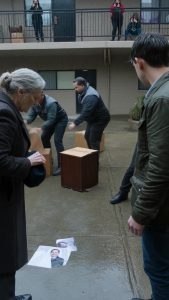
Tyler spent the afternoon carrying every box back upstairs.
No assistants.
No umbrella held over him.
Evelyn watched from the doorway.
When he reached Samuel’s tool chest, he paused.
It was heavier than it looked.
A neighbor said:
“Samuel carried that up alone when he was sixty.”
Tyler said nothing.
Inside Apartment 2B, he helped lay photographs across towels. One showed Samuel driving a city bus with children waving through the windows.
Tyler touched the edge of it.
“I didn’t know.”
Evelyn answered:
“You did not ask.”
That sentence became the real lesson.
Tyler later recorded a public apology without his father’s lawyers beside him.
He named Evelyn.
He named Samuel.
He named the seventeen tenants.
He admitted he had treated a missing online form as proof that a person no longer belonged in their own home.
The company created paper renewal options, in-person assistance, and independent review before any elderly tenant could be removed.
Evelyn eventually accepted compensation.
Not the first check.
A later agreement that repaired her home, replaced damaged belongings, covered legal costs, and contained no silence clause.
She framed the two torn halves of the original check beside Samuel’s bus cap.
Visitors asked why.
She said:
“That was the day they learned money could repair a chair, but it could not introduce them to the man they stepped over.”







Leave a Reply